How to Choose the Right Juniper Router for Your Network Needs?
Choosing the right Juniper Router for your network is crucial. It impacts performance, security, and overall efficiency. Understanding your network requirements is the first step. Different routers cater to various needs, whether you manage a small business or a large enterprise.
A reliable Juniper Router offers scalability and flexibility. But, the options can be overwhelming. Each router has unique features and capabilities. Evaluating your organization’s specific demands is essential. Consider current and future bandwidth needs, security features, and integration with existing systems.
Moreover, it’s important to look beyond specifications. The choice also involves support and options for upgrades. A router may seem perfect but might lack necessary support. Ensure the vendor offers solid technical assistance. Reflecting on these considerations can lead to a more informed decision. The right choice can enhance your network significantly.

Understanding Your Network Requirements for Juniper Router Selection
Choosing the right Juniper router starts with understanding your network requirements. Evaluate what your organization needs. Consider bandwidth, reliability, and scalability. A thorough needs assessment helps you choose effectively.
Think about your current and future growth. Is your network expected to expand? Choose a router that accommodates increased load and traffic. You may regret picking a model that can’t handle future demands, leading to costly upgrades.
Tips: Prioritize features like security and ease of management. Look for routers that offer advanced security protocols. This can protect sensitive data from breaches. An intuitive interface can simplify routine tasks, saving time and effort.
Analyze your network topology. Different setups require different solutions. A centralized approach differs from a distributed one, affecting your router choice. Reflect on your existing setup to avoid mismatches that hinder performance.
Router Performance Comparison
Evaluating Juniper Router Models Based on Performance Specifications
When selecting a Juniper router, performance specifications are key. Look at the router's throughput capabilities. This indicates how much data it can handle at once. For instance, consider the bandwidth requirements of your network. If your network has a high data demand, a router with higher throughput is essential.
Next, examine the routing protocols supported by the device. Compatibility with popular protocols ensures smooth communication within your network. Delve into the processing power and memory specs as well. These details impact the router's ability to manage multiple tasks without lag. It might be valuable to ask whether the current model meets future demands.
Another critical aspect is reliability, often reflected in uptime statistics. A router should have a proven track record to avoid disruptions. Pay attention to warranties and customer service ratings too. This reflects the manufacturer's commitment to quality. A router may have impressive specifications on paper, but real-world performance counts. Users often discover that what seemed perfect initially can fall short in practice. Validating reviews and performance reports is wise, as experiences vary widely.
Comparing Juniper Router Features: Scalability, Security, and Management
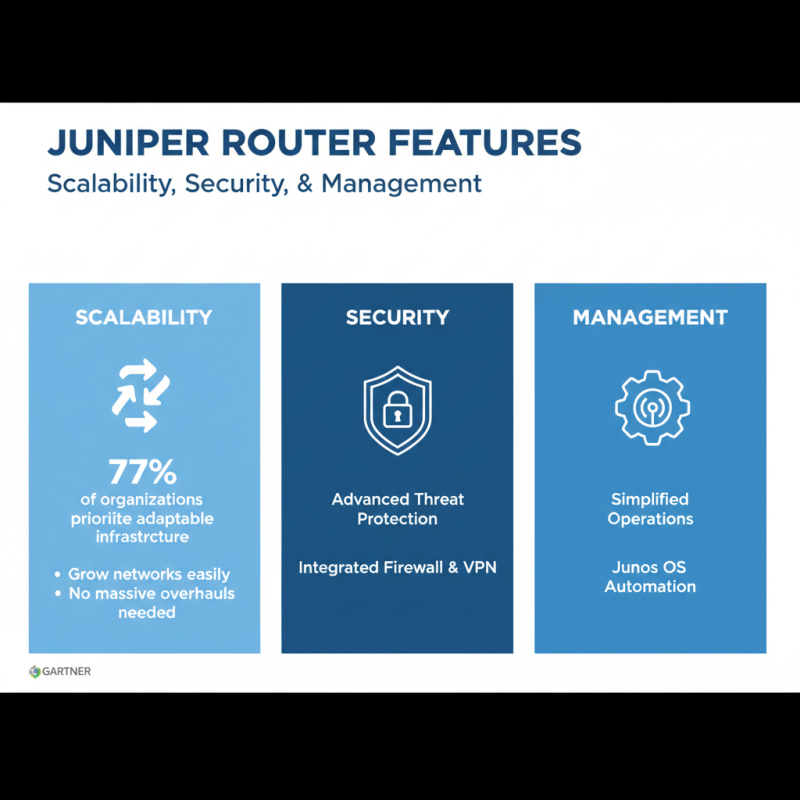
When selecting a Juniper router, three key features stand out: scalability, security, and management. Scalability is crucial for growing networks. According to a recent report by Gartner, 77% of organizations cite the need for adaptable infrastructure as essential for digital transformation. Juniper routers can expand easily to meet increasing demands, allowing businesses to scale without massive overhauls.
Security is another vital consideration. A study from the Cybersecurity & Infrastructure Security Agency highlights that 60% of data breaches are tied to inadequate security measures. Juniper routers offer built-in security protocols, including advanced encryption and threat detection, which protect sensitive data. This feature helps organizations maintain compliance, which is increasingly important in today’s regulatory climate.
Management capabilities influence operational efficiency. Network management solutions simplify configuration and monitoring. However, many IT teams report that user interfaces are sometimes complex, which could lead to mistakes. Enhanced management tools can address these challenges by allowing for better visibility and control over network performance.
Considering these factors leads to informed decisions on router selection, ensuring robust performance aligned with organizational goals.
Assessing Budget Constraints and Total Cost of Ownership for Routers
Choosing the right router involves more than just a purchase. A key factor is the
total cost of ownership (TCO).
TCO includes initial costs, maintenance, and operational expenses over the router's lifespan.
According to a recent industry report, companies often overlook the operational costs, which
can contribute significantly to the total expenditure.
Budget constraints shape network choices. When assessing your options, consider both upfront
costs and long-term impacts. A router might be affordable initially, but higher power
consumption can increase monthly bills. Research suggests that energy-efficient routers can
reduce operational costs by up to 30% annually.
Balance upfront savings against potential future costs.
Tips:
- Always calculate TCO before making a decision.
- Seek routers with robust technical support to avoid costly downtimes.
- Assessing energy efficiency is crucial.
- Invest in a router that can adapt to growing demands, even if it requires a higher initial outlay.
- Finding the right balance can lead to more sustainable networking solutions.
Analyzing Future Growth and Technology Trends for Network Infrastructure
As businesses grow, their network needs evolve. Choosing the right router is crucial for adapting to technological changes. Consider future data demands and ongoing trends in connectivity. Factors like cloud computing, IoT, and increased mobile access will shape your requirements. A robust router that can handle higher speeds will be essential in this fast-paced environment.
Worrying about scalability is common. A router must accommodate an expanding workforce and more devices. Think about your bandwidth needs. Can the current infrastructure support growth? These questions are vital as they point towards critical shortcomings. Additionally, security features should not be overlooked. As networks grow, vulnerabilities increase. Investing in comprehensive security will help protect sensitive information.
Future-proofing your network requires careful planning. Look for routers that offer flexibility and advanced capabilities. This may include better support for emerging technologies. However, be cautious of over-committing to features that may not be relevant. Regularly reassessing your infrastructure ensures it meets changing needs. Addressing these aspects proactively can lead to a more resilient and efficient network.